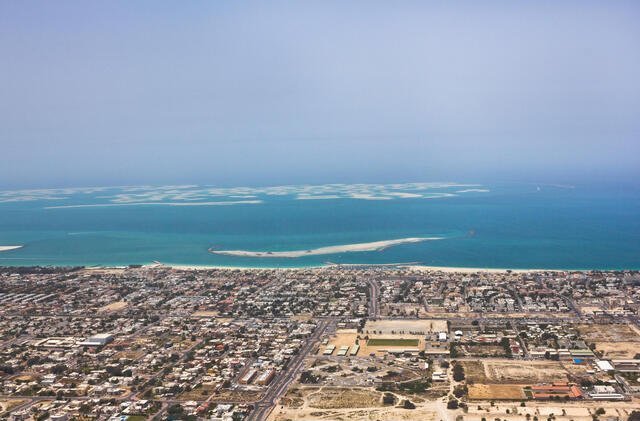

Ras Al Khaimah was, until recently, a quiet holiday and retirement market with modest pricing and thin transaction volumes. The announcement of Wynn Al Marjan Island, the UAE's first licensed gaming resort, due to open in 2027, changed the conversation entirely.
Why this catalyst is different
Most UAE demand stories rest on masterplans and population projections. This one rests on a specific asset, with a specific operator, a specific licence and a specific opening date. That makes it unusually assessable. Integrated resorts of this scale reliably generate large visitor volumes, and visitor volumes support hotel rates, short-let demand, retail and employment. The mechanism is well understood from other markets.
The secondary effects are already visible. Developers have launched a substantial pipeline of branded and hotel-managed residences on and around Al Marjan Island. Land values have moved sharply. International investor interest in RAK, previously negligible, is now material. Al Hamra, the neighbouring established community, has been pulled up alongside it.
What the numbers look like
Entry pricing on Al Marjan Island now starts materially above the historic RAK average, with branded product priced at levels that would have been unthinkable in the emirate three years ago. Short-let yields of 7% to 9% are being targeted on the strength of projected visitor demand. Al Hamra, more established and less repriced, offers 7% to 8% on genuinely delivered golf and marina product.
Where the risks concentrate
Much of the good news is priced. This is the central issue. Buying today means paying for an outcome that has not yet occurred. If the resort opens on time and performs as modelled, current pricing may look reasonable in hindsight. If it slips, or if visitor numbers disappoint, there is limited cushion.
Supply is heavy and concurrent. A large volume of similar branded apartments is due to complete between now and 2028, much of it aimed at the same short-let market. That is a familiar pattern, and it usually compresses returns for the units that complete into the thickest part of the wave.
Single-asset dependency. The thesis leans heavily on one project. Diversified demand drivers, of the kind Dubai has, are not yet in place.
Liquidity remains thin. RAK's resale market is far shallower than Dubai's. Exiting a specific unit can take time, particularly if many comparable units come to market together after handover.
How we would approach it
- Compare against pre-announcement benchmarks to see explicitly how much of the story you are paying for.
- Prefer delivered product where the economics can be verified, which currently favours Al Hamra over the newest Al Marjan launches for conservative buyers.
- Scrutinise operator agreements on hotel-managed units: who controls letting, what the fee split is, and whether returns are guaranteed or merely projected.
- Check handover timing against the resort's own schedule. Completing well before the resort opens means carrying an asset into an immature market.
The balanced view
Ras Al Khaimah is a genuine opportunity with a genuine catalyst, and dismissing it would be a mistake. So would treating a 2027 opening as a guarantee of 2026 pricing. Buy it as a five-year hold with a tolerance for volatility, not as a quick trade.